


This is the piece of gear you buy hoping you never touch it. But the day you need it, nothing else matters, so it's worth getting right.
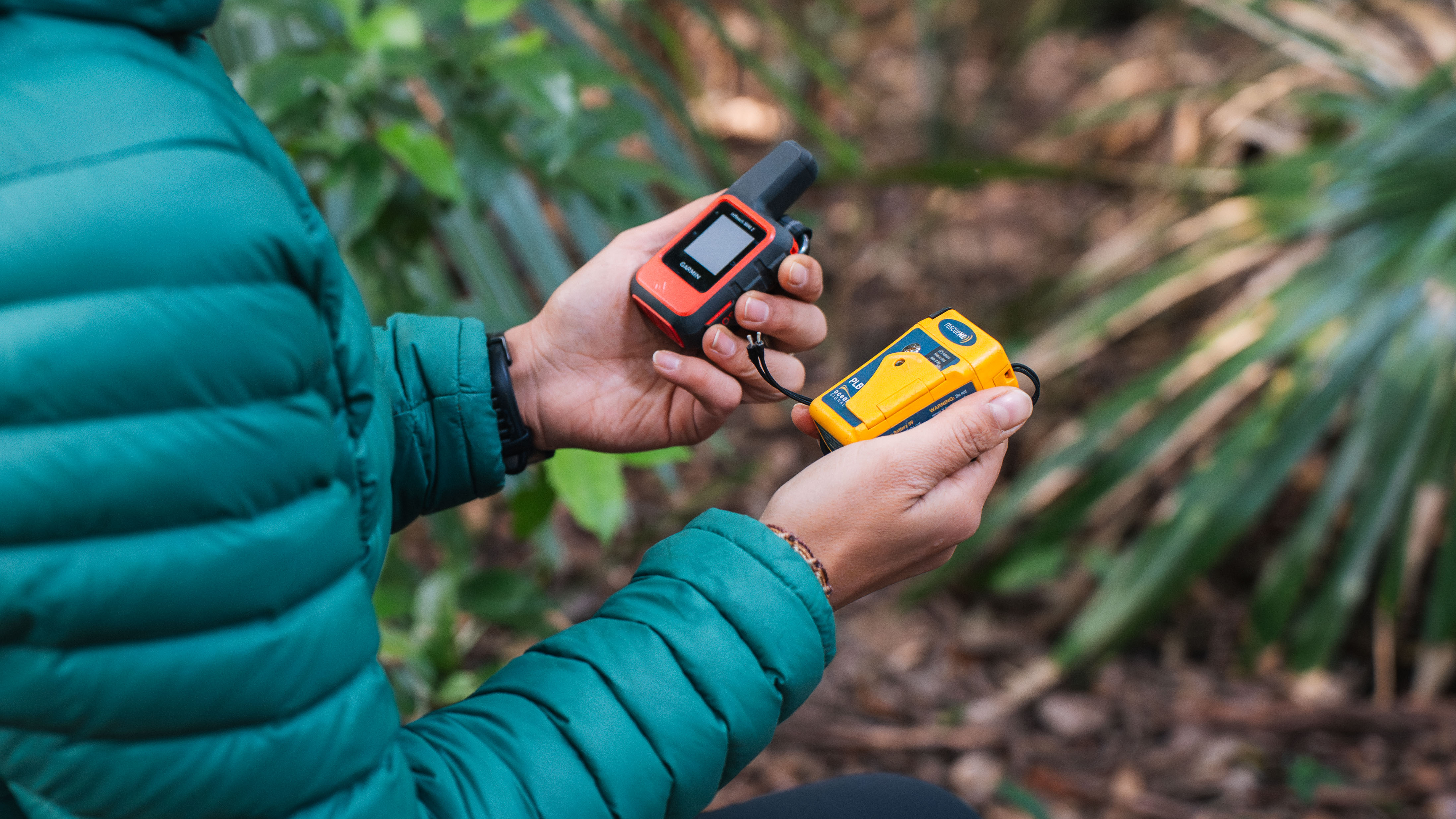
I've carried both. For years it was an Ocean Signal rescueME PLB1, then in 2024 I switched to a Garmin inReach Mini 2 for my first multi-week adventure. I'd have called it a toss-up until recently, but a change to how Garmin handles subscriptions is why I now think a satellite communicator is the smarter buy for most people.
The short answer
For regular hikers in 2026, I’d take a Garmin inReach over a standalone PLB, I'd take a Garmin inReach over a standalone PLB. You get two-way communication instead of a one-way distress signal, and Garmin now lets you keep emergency SOS active even while your subscription is paused, up to 12 months. That removes the biggest reason people used to pick a PLB: ongoing cost.
A PLB still makes sense if you want the cheapest, simplest option, with zero admin and a device you can store for years and trust instantly. More on who that suits below.
And no, your iPhone isn't a replacement for either. Good backup. Not the plan.
PLB vs satellite communicator
Both can save your life, they just work differently.
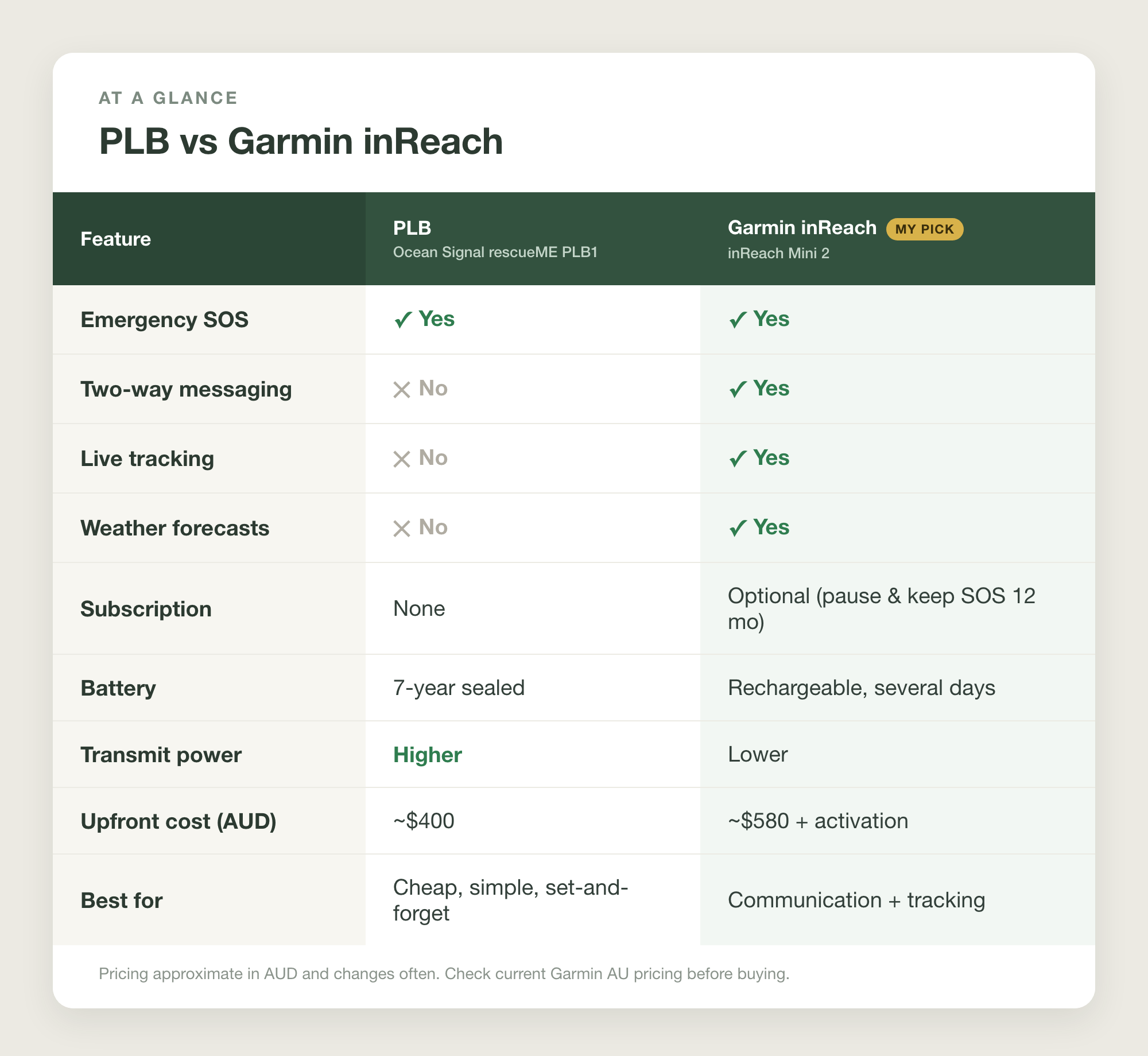
A PLB (Personal Locator Beacon) does one thing: activate it and it fires a one-way distress signal with your GPS location to the global Cospas-Sarsat search and rescue network. No subscription, no messaging, just SOS. The rescueME PLB1 weighs 116g, has a 7-year sealed battery, and costs around $400. Almost no upkeep beyond a monthly self-test and a yearly GPS test. It also transmits at higher power than an inReach, so it punches through tree canopy and dense bush better, which matters across a lot of Australian terrain.
One thing worth knowing before you buy a PLB. Most of them, including the PLB1, are properly one-way. You press the button and then you sit there with no idea whether anything actually happened. The GME MT620GR is an exception. It has Return Link Service, so the satellite network sends a confirmation back down and the beacon tells you your alert has been received by a Rescue Coordination Centre. GME is an Australian brand, designed and made here, and it currently runs around $499 to $569. More than the PLB1, but if you hike alone, knowing the message got through is worth the extra.
A satellite communicator like the inReach Mini 2 does all that and more. It sends an SOS, but also lets you message back and forth with the rescue centre, text family when you're out of range, pull weather, and share live tracking. Most of that needs a subscription, and the battery is rechargeable rather than sealed, so you charge before you go and top up on longer trips. In normal tracking use I get several days, then recharge from a power bank.
What changed (and why I switched)
In June 2026 Garmin updated their policy so you can suspend your inReach subscription after one month and keep emergency SOS for up to 12 months, at no extra cost. It applies to the Mini 2, Mini 3 and Fenix 8 Pro (the original Mini 1 misses out), and after 12 months it auto-reactivates the basic plan so you don't accidentally lose SOS.
Why it matters: people chose a PLB to avoid paying year-round for something they might use a handful of times. Now you can buy the inReach, run the cheapest plan only in the months you hike, pause it the rest of the year, and stay covered. The maths that used to rule out an inReach for occasional hikers doesn't really hold anymore.
One catch for existing owners: you may need to update your device firmware to switch to the new plan. Sort it before your next trip, not at the start of your next hike.
Why two-way matters
Set off a PLB and rescuers know your location and that someone's in trouble. That's it. They don't know if you've broken an ankle, how many of you there are, or if you've already self-rescued, so they plan for the worst.
With an inReach you can tell them: “Suspected broken leg, two hikers, sheltered, warm layers and water.” That gives rescuers more information about what they’re responding to. It’s also useful if you come across someone else who needs help. You can report their emergency and continue communicating with rescuers, whereas activating a PLB for someone else may mean leaving the beacon with them.
What about the iPhone SOS feature?
Newer iPhones have Emergency SOS via satellite, and it works in Australia. Great to have in your pocket, but don't treat it as your primary device:
- It needs a clear view of the sky. Under canopy, in a gorge, or down in a valley it struggles, and a lot of Australian hiking is exactly that. You can lose reception in a Blue Mountains valley a few kilometres from Katoomba.
- Your phone is your most fragile kit. It dies in the cold, runs flat from filming, breaks when you drop it. A dedicated beacon holds its charge for the one moment you need it.
- It's a backup, not a system. A brilliant second layer, not a reason to leave a proper device at home.
The real cost over time (in AUD)
Cost is why most people lean PLB, so let's run it.
A PLB is cheaper up front, around $400, no subscription. But the battery is sealed and expires after about 7 years, and servicing runs roughly $150 to $200. So it's "buy once, service every 7 years," not "buy once." If you want that similar no-subscription setup but you'd rather know your signal landed, look at the MT620GR instead.
An inReach Mini 2 is often around $580 on sale, plus a one-off activation fee (about $70), plus the cheapest plan only in the months you hike (roughly $15 a month, paused the rest of the year). Hike six months a year and that's about $90 in plan costs annually.
Over a 7-year horizon the inReach still comes out dearer once you add it all up, but nowhere near the old gap, when an inReach meant paying every month of the year. You're paying a bit more for a device that does far more. Check Garmin's current AU pricing, it shifts.
Don't skip this: register your beacon (Australia)
If you buy a 406 MHz PLB, register it with AMSA (the Australian Maritime Safety Authority). Registration is free and takes a few minutes online. Registrations don’t expire, but you should keep your contact and emergency details up to date. That means if you ever activate your beacon, AMSA has the information it needs to identify you, contact your nominated emergency contacts and assist with the response.
Garmin inReach SOS runs through the Garmin Response coordination centre rather than AMSA, but the principle is the same: set up your emergency contacts before your first trip.
A beacon is not a rescue button
This gets glossed over, and it's the most important thing here. Setting off a beacon doesn't rescue you. It tells someone you need rescuing. That's the start of the process, not the end.
Help can be hours away. Sometimes days. If the weather grounds a helicopter, and in the Australian bush it often does, you could be waiting a long time for ground crews over rough terrain. Your beacon won't keep you warm, treat a snake bite or a broken ankle, or shelter you while you wait.
Whichever you carry, the device is only half the equation. The other half is keeping yourself alive until help arrives: warm layers, an emergency bivy or space blanket, a first aid kit you know how to use, enough food and water, and the navigation skills to avoid trouble in the first place. Carry the beacon, then pack as if you might have to wait.
What I carry and why
Right now I carry the Garmin inReach Mini 2. The two-way messaging sold me: I can send my mum an "all good, heading back now" from places with zero phone reception, and the live tracking gives everyone at home peace of mind, which takes pressure off me too. I've never had to hit SOS, but I use the messaging on almost every overnight trip. It can help off the trail as well, a flat tyre out of range and you can still call for help.
Before this I carried the Ocean Signal rescueME PLB1. Nothing bad to say about it. Tiny, tough, 7-year battery, does its one job without ever asking for money again. If a friend wanted a no-fuss, no-subscription beacon, I'd still point them at it.
So which should you buy?
Buy a Garmin inReach if:
- You want two-way communication, not just a distress signal
- You hike, camp or travel often enough to use messaging, weather or tracking
- You like family being able to see you're okay
- You're happy to manage a subscription, especially now you can pause it and keep SOS
Buy a PLB if:
- You want the lowest cost and zero ongoing fees
- You want something you can store for years and trust to work instantly
- You only head out occasionally and want no admin
- Simplicity is the whole point
There's no wrong answer. The wrong answer is carrying nothing, or assuming your phone has it covered.
Bottom line
A year ago I'd have called this a coin-flip. Now, with SOS staying live while your plan's paused, the inReach is the smarter buy for most hikers. But carry something, register it, and tell someone your plan before you leave. That's what actually keeps you safe.
Questions or your own take on PLB vs inReach? Leave a comment below, I'd love to know what you carry and why.